
How to split a restaurant bill fairly
When an even split is fair, when to split by item, and how to handle tips and service—plus how Tab.team ends napkin maths with no guest app download.
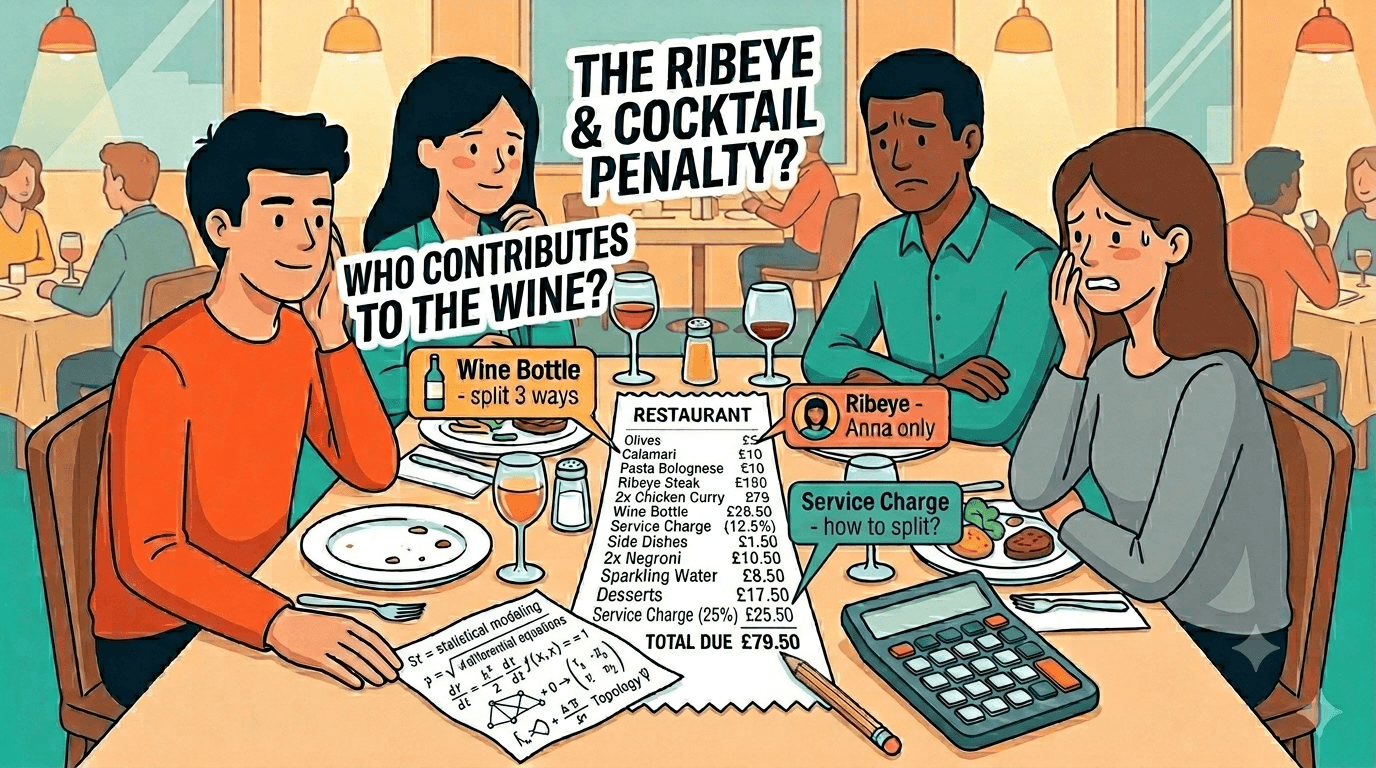
Let's be honest: the moment the bill or check lands on the table, something shifts. The conversation that was flowing so beautifully ten minutes ago suddenly goes very quiet. Someone stares at their phone. Someone else starts doing maths on a napkin. And then comes the inevitable: "shall we just split it evenly?"
For a lot of tables, that's fine. But for a lot of others, it absolutely isn't — and research backs this up. According to a Zopa Bank study, one in three people regularly overpay on shared bills and checks to avoid an awkward conversation, racking up a so-called "politeness penalty" of £240 a year on average. Young diners aged 25–34 are worst hit, with 44% saying they frequently pay for far more than they actually ordered.
Rupert Wesson of Debrett's is blunt on the subject: "It is wrong to assume we know enough about everyone's finances to assume they can subsidise the dining habits of everyone at the table." In other words, fairness isn't rude. Expecting someone on a tight budget to quietly subsidise your ribeye and three rounds of cocktails is.
When even works, and when it really doesn't
An even split makes perfect sense when everyone ordered roughly the same — a round of mains, a couple of shared sides, similar drinks. The gap between people is small, the admin is minimal, and the awkwardness of getting out a calculator outweighs the few pounds in play. Carry on.
The moment that stops being true, even splits stop being fair.
Consider the teetotaller who drank sparkling water all evening while the table ran up £90 of wine.
Or the person who ordered the cheapest dish on the menu because they were watching their budget, only to find themselves splitting a bill or check that includes someone else's fillet steak. Or three families dining together — one with four adults and teenagers who ordered everything, one couple who had a quiet main each, and a third with small children on kids' meals. An equal three-way split in that scenario isn't equitable; it's one family subsidising the others.
The etiquette guidance here is consistent: pay for what you ordered. It isn't tight. It isn't awkward. It's accurate.
The tip and service charge question
Once the food is sorted, the surcharges need handling. Whether it's a service charge printed on the bill or check or a tip you're adding voluntarily, the same question applies: split it evenly across all payers, or proportionally — so those who spent more on food and drink contribute a little more?
Both are perfectly reasonable approaches, and the right answer is simply the one the group agrees on before someone reluctantly puts their card in.
What to do before you even sit down
Debrett's Wesson puts it well: "It's always best to try and establish, at least in general terms, how things are being done before everyone gets stuck in." Before plates arrive, one quick sentence — "shall we split by what we ordered tonight?" — removes all ambiguity and means nobody is silently fuming over the dessert course.
If you're the host or organiser, you can set the tone. Most people are relieved when someone just says it out loud. It's the not saying it that creates the tension.
How Tab.team handles all of this
Tab.team is built precisely for the situations where an even split falls apart.
Snap the receipt, and the AI reads every line item and lays them out as a stack of cards to be claimed, assigned, or split. The service charge, tax, tip, and any discounts are identified separately — and the host decides how each one is handled on the finish screen.
The host can do all the assigning themselves in solo mode, or invite the whole table to join the session via a QR code or share link. Guests claim their own items directly from their phone — no app download, no account needed. For any item shared between two or more people, Tab.team allows fractional splits to the nearest 1%, so a bottle split three ways slightly unequally, or a starter where one person had most of it, can be divided precisely rather than guessed at. The same percentage-based precision applies to how service charge, tip, tax, and discounts are handled.
When the last item is claimed, the host reviews the surcharges — choosing even or proportional splits for each — and everyone sees their exact total, ready to share via WhatsApp or email in one tap. No chasing. No napkin maths. No awkward silence.
Tab.team works for restaurants, bar tabs, and takeaway orders — anywhere one receipt lands on a table with more than one payer, up to 20+ people simultaneously. And it's free for everyone at the table, every time.
Ready to stop overpaying? Split your next bill or check with Tab.team — no download needed.